
Idea behind the game
Understanding the dilemma of science communication
The Central Problem
The Challenge of (Un)certainty
The Scientific Reality
This does not refer to a feeling of uncertainty or certainty, but rather to the uncertainty of scientific findings: It is simply impossible to provide absolute, 100% proof that things (technologies, medicines, food, etc.) do not harm us in any way. This also applies to comparatively well-researched topics such as “mobile phone radiation and health,” which has been the subject of approximately 30 years of research.
Reasonable Expectations
An Impossible Balance
Making the Dilemma Tangible
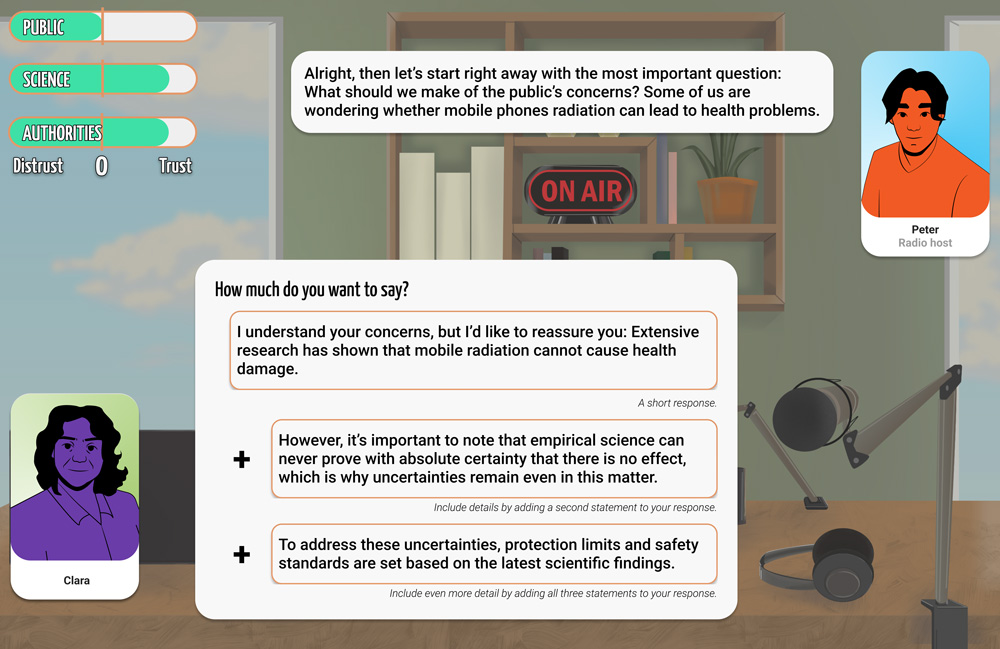
This is where the idea for the game came from: it aims to contribute to understanding between science and the public by making this dilemma of science communication tangible. As game developers, we hope that “Talk Science” will encourage people to reflect on their expectations towards science communication. The aim is deliberately not to lecture players, but simply to enable them to experience why science communication is a difficult process in which it is impossible to satisfy all parties involved.
Why are scientific findings often communicated in a way that the relevant sections of the public can hardly make sense of them? “Talk Science” is based on the experience that “(un)certainty” is a key factor that makes communication difficult. This does not refer to a feeling of uncertainty or certainty, but rather to the uncertainty of scientific findings: It is simply impossible to provide absolute, 100% proof that things (technologies, medicines, food, etc.) do not harm us in any way. This also applies to comparatively well-researched topics such as “mobile phone radiation and health,” which has been the subject of approximately 30 years of research.
Nevertheless, it is understandable and also reasonable that people who are confronted with a new technology are skeptical and want proof of complete safety. If, for example, a new cell phone tower is erected in a town, it is understandable that some people are concerned about this and demand proof of safety. However, when it comes to (un)safety, science cannot deliver 100 percent of what the population often wants.
Experience shows that this a central dilemma for science communication. When science communicators emphasize the uncertainties that inevitably accompany scientific findings, they are meeting the expectations of the scientific community. At the same time, however, they are disappointing the expectations of the general public. If they communicate too little uncertainty, the opposite picture emerges.
This is where the idea for the game came from: it aims to contribute to understanding between science and the public by making this dilemma of science communication tangible. As game developers, we hope that “Talk Science” will encourage people to reflect on their expectations towards science communication. The aim is deliberately not to lecture players, but simply to enable them to experience why science communication is a difficult process in which it is impossible to satisfy all parties involved.